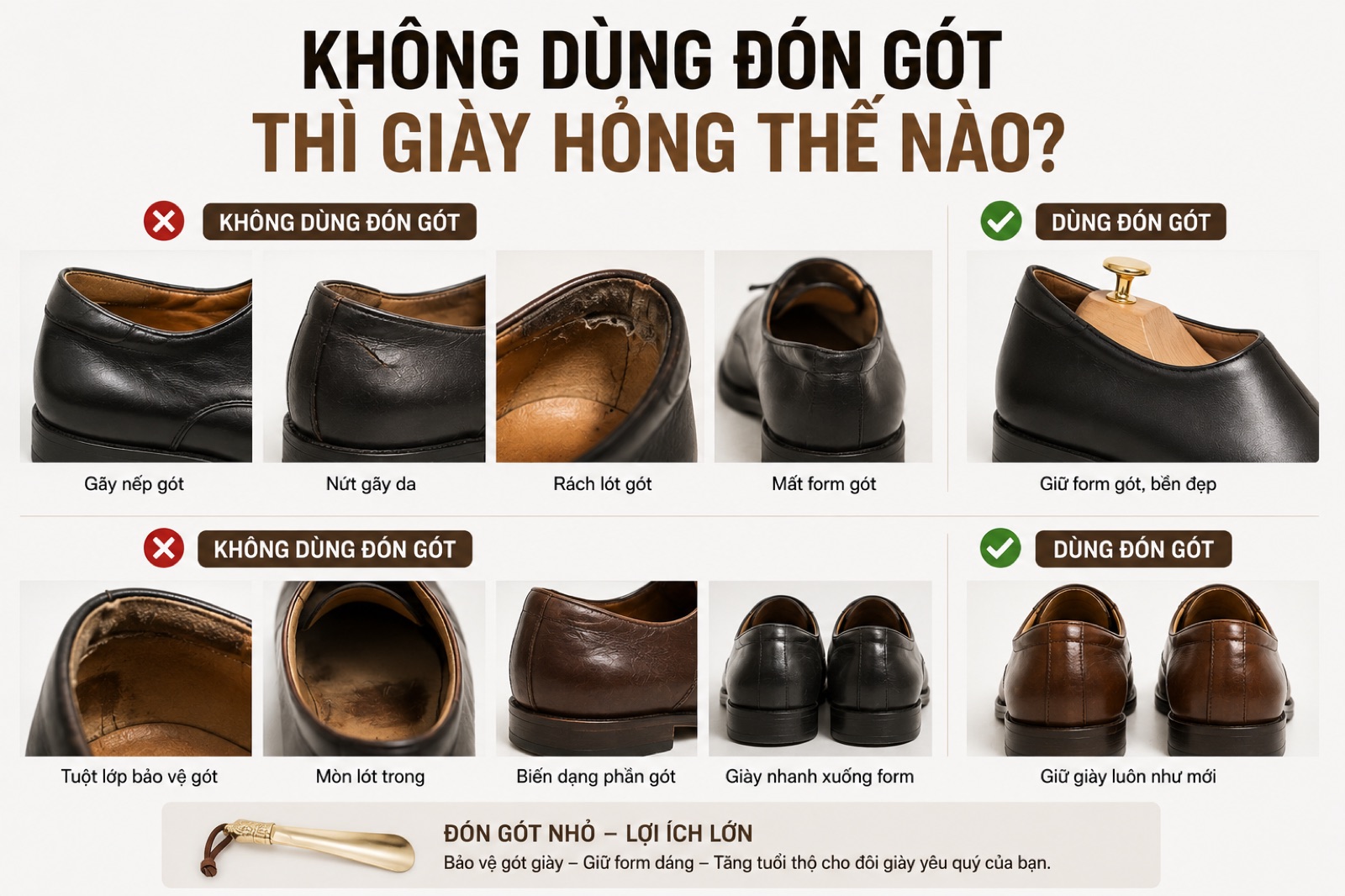
Skipping the shoe horn ruins the heel: every forced entry folds the counter, and over time it crumples, creases, delaminates the heel lining and deforms the back of the shoe — an area that's hard to repair and affects both fit and shape.

Official partner Saphir (France) & Santoni (Italy); featured by VTV, VnExpress and Dân Trí.
The full answer
When you force your foot into a shoe, the heel counter gets crushed and springs back repeatedly; the leather and the stiffener inside the heel crack, soften, and gradually collapse. The result: a "broken" heel, shoes that slip off, lost shape, and a peeling insole. A shoe horn lets your foot slide in smoothly and keeps the heel intact — an inexpensive item that protects the most expensive part of your shoes. Keep one by the door and one in your bag or car.
Gazano offers leather shoe horns for 135,000₫ — keeping your heels in great shape for years. — see service details or chat Zalo.
Are shoetrees really necessary — cedar or plastic?
Shoetrees are truly essential — arguably the most important accessory for leather shoes. They hold the shape, absorb interior moisture, shallow out creases and prevent deformation. Choose cedar: it also deodorizes and cuts the risk of mould.
What do leather & herbal insoles do, and how often to replace them?
Leather and herbal insoles absorb sweat, deodorize, resist bacteria and cushion the foot — while protecting the shoe's original lining. Replace them once flattened, smelly or soiled — every few months on average, depending on wear and sweat.
Do nano waterproofing sprays really work, and on which leathers?
Nano waterproofing sprays DO genuinely work, and are most useful on suede/nubuck and fabric sneakers — they form an invisible barrier against water and dirt. On smooth leather (calf/box) already protected by wax polish, the benefit is smaller. Choose a water-based spray and avoid silicone-based ones, which clog the leather's pores.