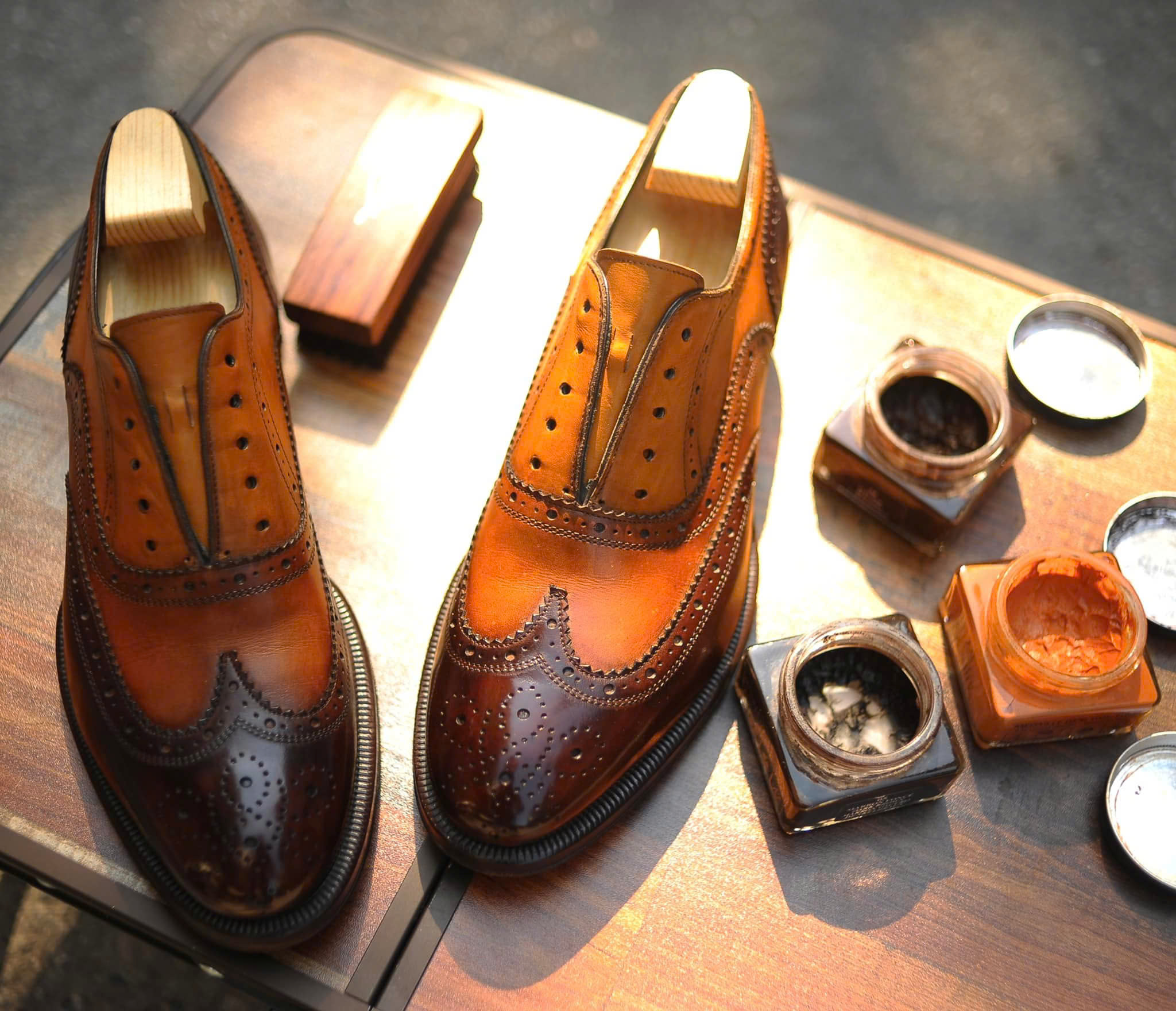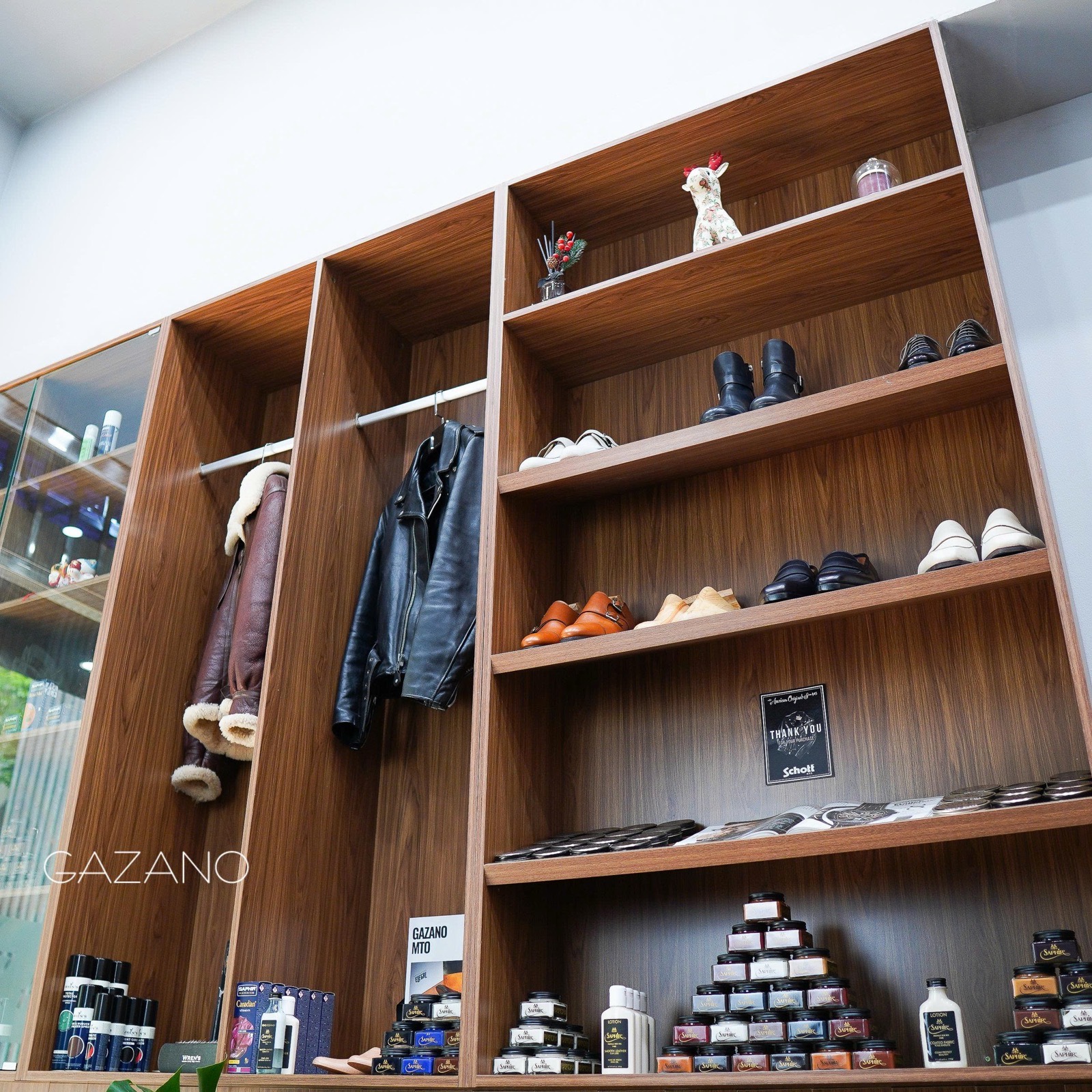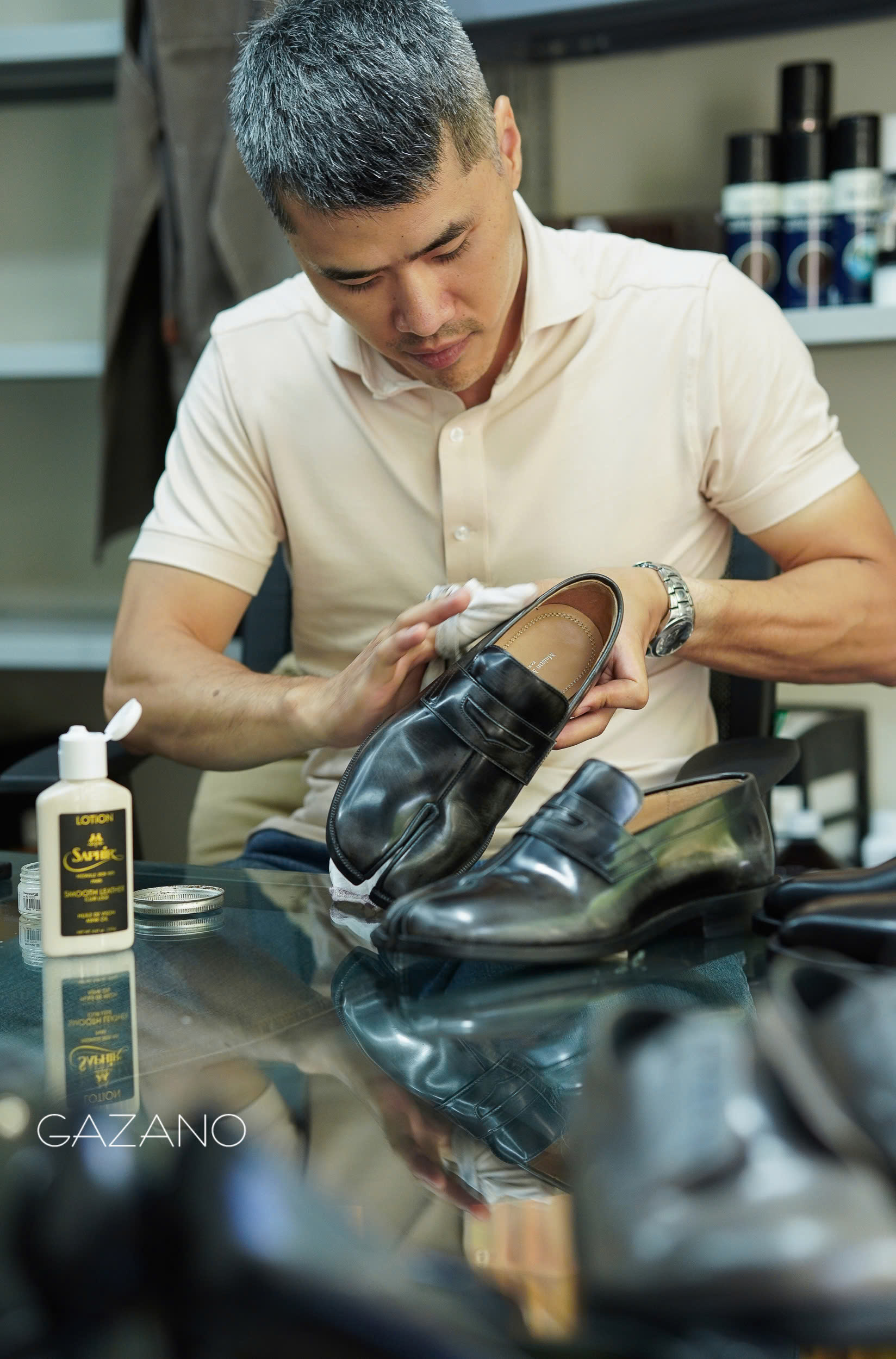
Here are the 50+ questions Gazano customers ask most often about leather shoes, leather goods, and care routines. Every answer was written by our team of experts with 8 years of experience handling tens of thousands of pairs in Hanoi. Use the table of contents below to jump to the question you care about.

Below are the questions customers send Gazano most often, compiled and answered concisely by our technical team. If your question isn't covered here, message us on Zalo or call 0936.297.486 for personalized advice.
Polishing & conditioning
1. How often should I polish my shoes?
For smooth leather shoes worn regularly, polish every 2–4 weeks, or as soon as the leather starts looking dry and slightly faded. More important than frequency is the habit of brushing off dust after every wear and regular leather conditioning — polish is only the outer finishing layer.
2. What's the difference between cream and wax polish?
Cream absorbs into the leather to replenish oils, keeping it supple and preventing cracks — this is the "nourishing" step. Wax sits on the surface to add shine, enrich color, and protect against light scratches — this is the "protect & beautify" step. A complete routine needs both: condition first, then wax.
3. Do expensive leather shoes need different care from regular ones?
Yes. The more valuable the shoes, the more they warrant premium products like Saphir Médaille d'Or and a gentle touch. For your most important pairs (Goodyear-welted dress shoes, box calf, patina leather), let Gazano handle the advanced steps instead of doing them at home, to avoid the risk of damaging the leather's surface.
4. Can I do a Mirror Shine at home?
In theory, yes — but a Mirror Shine requires many thin layers of wax, proper water-drop technique, and a great deal of time; done wrong, it easily leaves streaks and cracks the glossy layer. It's a technique Gazano recommends leaving to a professional — especially for the toes and heels of dress shoes.
Cleaning & common problems
5. Should I wash leather shoes with water?
Avoid washing directly with water when it comes to smooth leather. Leather that absorbs water becomes stiff, loses its shape, and cracks easily once dry. Clean instead with a dedicated solution (such as Saphir Renomat) applied to a soft cloth. Some sneakers and synthetic leathers can take a light wet clean — if unsure, ask Gazano first.
6. What should I do if my shoes get soaked in the rain?
Wipe the surface dry right away, stuff newspaper inside to absorb moisture and hold the shape, and let them dry naturally for 24–48 hours in a well-ventilated spot. Never blow-dry or leave them in direct sun, as heat makes leather shrink and stiffen. Once fully dry, recondition with cream to replace the lost oils.
7. What do I do about white mold on my shoes?
Take the shoes somewhere airy and brush off the outer mold with a dry brush (do it outdoors to avoid inhaling spores), then wipe with a dedicated anti-mold solution and recondition the leather. If the mold has penetrated deep or spread widely, bring them to Gazano — we have a dedicated mold treatment process. See the full guide in Treating mouldy shoes.
8. How do I get rid of shoe odor?
Odor usually comes from moisture and bacteria. Be sure to insert cedar shoe trees after every wear to absorb moisture and fight bacteria naturally, add desiccant packets or baking soda overnight, and rotate 2–3 pairs rather than wearing one pair continuously. For heavy odor, Gazano offers a deep sanitizing clean.
Suede & sneakers
9. Is caring for suede/nubuck different from smooth leather?
Completely different. Suede takes no cream or wax polish — instead, use a suede brush to lift the nap, a dedicated eraser for stains, and a nano waterproofing spray for protection. Strictly avoid water and oil, as they will mat down the nap.
10. Can yellowed sneaker soles be whitened?
Rubber soles yellowed by oxidation can be improved significantly with a dedicated whitening technique, but it takes the right products and real care to avoid damaging the sole. It's easy to ruin without experience — see the guide and warnings in Removing sneaker sole stains, or let Gazano handle it.
Products & tools
11. What kind of brush should I use for leather shoes?
You need at least two: horsehair brush for daily dusting and buffing (soft and scratch-free), and a boar-bristle brush reserved for working in polish. Keep a separate brush for each polish tone (black / brown / neutral) to avoid color transfer.
12. What product brands does Gazano use?
Gazano's first choice is Saphir Médaille d'Or — the most premium line from French brand Saphir — along with Wren's products and genuine imported specialty accessories. All are available at Gazano products.
13. Should I use waterproofing spray on leather shoes?
Yes — especially for suede and sneakers, use a dedicated nano waterproofing spray: hold the can 20–30cm from the shoe, apply one thin even coat, and let it dry naturally. On premium smooth leather, choose the spray carefully so it doesn't alter the surface; if unsure, ask Gazano which type suits each material.
Storage & keeping
14. How do I store shoes properly for the long term?
Clean and condition the leather thoroughly before storing, insert wooden shoe trees to hold the shape, wrap in a breathable fabric bag (never a sealed plastic bag), and keep in a dry spot away from humidity and direct sunlight. Add a desiccant packet in the box. Every few months, take them out to "breathe" and inspect them. See also Storing leather in Hanoi's weather.
15. Are shoe trees really necessary?
Absolutely, for quality leather shoes. Cedar shoe trees help hold the shape, absorb sweat moisture and fight mold naturally, and keep the leather from creasing and cracking at the toe. Insert them right after you get home, while the shoes are still warm and damp — a small investment that significantly extends your shoes' lifespan.
Gazano services
16. Does Gazano offer home pickup?
Yes. Gazano offers home pickup, expert treatment, and on-time return within Hanoi — no travel time on your part. Book via the form on our website, Zalo or the hotline 0936.297.486 (CS1) / 0915.059.086 (CS2).
17. What about cost and turnaround time?
Cost and turnaround depend on the service type and each pair's actual condition (cleaning, color restoration, sole regluing, mold treatment…). For an accurate quote, send photos of your shoes via Zalo or call the hotline — the Gazano team will advise and quote a specific price before taking in your items.
Hanoi weather
18. How do I protect leather shoes during Hanoi's damp season (February–April)?
During the damp season, humidity hits 85–95% — the highest mold risk of the year. Solutions: (1) place 4–6 silica desiccant packets in your shoe cabinet and replace them weekly; (2) run a room dehumidifier when possible; (3) do NOT store shoes in sealed cardboard boxes — switch to fabric bags; (4) insert cedar shoe trees right after you get home; (5) dry-brush off dust every 3–4 days even when unworn, so moisture doesn't build up. At the first white spot, act immediately following the mold treatment process.
19. Leather shoes cracking in dry winter weather — how do you fix it?
Light cracking in flex areas (toe, heel, collar) is caused by moisture loss. Recovery process: (1) lightly dampen with a wrung-out cloth; (2) apply a moderate amount of Saphir Renovateur and let it absorb for 30 minutes; (3) repeat 2–3 times during the first week; (4) then condition every 2 weeks throughout the dry season. If the cracks are deep enough to expose the lining, bring the shoes to Gazano — a specialized restorative coating may be needed.
20. Heavy sweating in hot summers — do shoes need extra conditioning?
Yes. Sweat contains salt and acid that corrode leather from the inside over time. Summer recommendations: (1) insert shoe trees as soon as you get home to absorb sweat; (2) rotate between 2–3 pairs (shoes need 24–48 hours to dry completely); (3) use Gazano herbal insoles or activated-charcoal insoles; (4) wipe the inside of the shoes with a wrung-out damp cloth once a week; (5) condition on a shorter cycle — every 3–4 weeks instead of 6.
21. Should you wear leather shoes during Hanoi's heavy rain showers?
Avoid it if you can. If you must: (1) apply Wren's Nano waterproofing spray 24 hours before wearing (the spray must dry completely); (2) choose shoes with rubber soles, never leather soles; (3) carry a spare shoe bag; (4) wipe the shoes dry IMMEDIATELY when you get home and insert shoe trees. Absolutely avoid Goodyear Welt shoes, premium calfskin, or suede/nubuck shoes in the rain — even light rain.
22. Storing leather shoes in an air-conditioned room — does it cause any harm?
It's actually much better than a regular room. Air conditioning keeps humidity stable at 45–55% — ideal for leather. Just avoid placing shoes directly in the cold airflow (it dries the leather too quickly). Keep shoes on an open shelf at least 1m away from the AC vent. Air-conditioned rooms also need fewer desiccant packs (1–2 packs per cabinet is enough).
By shoe brand
23. How does caring for Goodyear Welt shoes (Allen Edmonds, Crockett & Jones) differ from regular shoes?
Goodyear Welt construction is complex: leather upper + welt (the connecting leather strip) + sole. Recommendations: (1) condition the welt as well — the seam area dries and cracks quickly; (2) use the Saphir Médaille d'Or line exclusively and avoid cheap silicone-based products; (3) polish the upper–welt junction carefully with a small brush; (4) resole when worn (don't wait until the upper tears); (5) we recommend professional deep maintenance at Gazano every 6–12 months.
24. Yellowed soles on Air Jordans or Yeezys — does Gazano handle that?
Yes. White Boost soles (Yeezy) and Air midsoles (Jordan) both oxidize and yellow over time. Gazano uses de-yellowing solution #7, formulated specifically for premium sneaker rubber, without damaging the material. Note: Yeezy 350 V2 midsoles cannot be fully restored to pure white — that's inherent to the material. Pricing is per pair; send photos via Zalo for a consultation.
25. How much does it cost to clean a Hermès or Louis Vuitton leather jacket?
Designer leather jackets require careful handling given their high value and special finishes. Gazano services leather jackets from Hermès, LV, Bottega, Saint Laurent, and Givenchy with a dedicated process (gentle cleaning + deep conditioning). Pricing depends on: (1) leather type (nappa, lambskin, suede); (2) condition (light/moderate/heavy); (3) whether color restoration is needed. Send photos and details via Zalo for an accurate quote.
26. Faded Coach or Michael Kors handbags — can the color be restored?
Yes, in most cases. The process: (1) assess the condition (light fading, deep fading, or peeling); (2) clean the base; (3) restore the color with Saphir alcohol-based dye or Wren's color refresh; (4) seal the color with a specialized finishing solution. Note: PU-coated bags (like the Michael Kors Jet Set) differ from genuine leather — the process and pricing differ. It's best to bring the bag directly to our Vo Van Dung store for an in-person assessment.
27. How do you care for Dr. Martens and Red Wing boots?
Pull-up leather workboots (Dr. Martens 1460, Red Wing Iron Ranger) have a special oil-infused finish. Use dedicated products: (1) Saphir Mink Oil or Red Wing All Natural Boot Oil; (2) do NOT use Mirror Shine wax polish — it destroys the signature "pull-up" effect; (3) apply with a soft cloth and the warmth of your hands; (4) oil absorbs best while the boots are still warm (right after wearing). If you want a high shine instead of the natural pull-up look, use Saphir Pâte de Luxe — but you'll lose the original character.
28. Do Birkenstocks need leather conditioning?
Yes, for the upper. Birkenstocks use nubuck (or smooth leather, depending on the model) — condition every 2–3 months. The footbed is cork + jute; do NOT treat it with leather oils — only dry-brush it and air it in gentle sunlight. When the cork starts to crack, the dedicated Birkenstock Cork Sealer can be applied — Gazano can handle this or advise you on buying the genuine product.
29. How is a nappa leather jacket different from regular cowhide?
Nappa is calfskin or young lambskin — ultra-soft and smooth with a lightly glossy finish. Compared with regular cowhide: (1) it's thinner and scratches easily → use the gentle MDO Lotion instead of regular Renovateur; (2) its colors run deeper and are hard to restore once faded → see a specialist; (3) it can't withstand prolonged direct sunlight; (4) washing or heavy water exposure → permanent deformation. Nappa jackets from Hermès or Saint Laurent should be conditioned every 2 months — do NOT polish them yourself.
Saphir/Wren's Product Details
30. What's the difference between Saphir Renovateur and Saphir MDO Renovateur?
Saphir Renovateur (standard line, ~450,000₫) and Saphir Médaille d'Or Renovateur (premium line, ~880,000₫) differ in several ways: (1) MDO contains more mink oil and lanolin → deeper conditioning; (2) MDO is completely colorless → no risk of staining light leathers; (3) it absorbs better into premium leathers (calf, box leather); (4) it lasts longer (one jar covers 1–2 years). Recommendation: for shoes under 5 million VND, use regular Renovateur; for premium shoes, use MDO.
31. How long does a 50ml jar of Saphir Pommadier last?
Polishing one pair every 4–6 weeks, a 50ml jar lasts about 2–3 years. Each application needs only a pea-sized amount. If you're caring for 2–3 pairs, expect 1–1.5 years. Storage: keep the lid tightly closed, in a cool spot away from sunlight — the polish will retain its original properties. If it dries out and hardens, a few drops of Saphir solvent can restore it.
32. Do you need both Saphir Renomat and Saphir Pommadier?
It depends on your routine. Renomat (~580,000₫) is a deep cleaner that strips old polish, used every 3–6 months; Pommadier (~350,000₫) is a colored cream polish, used every 4–6 weeks. You can skip Renomat if you only do light maintenance, but after 8–10 consecutive polishes, the built-up wax must be stripped with Renomat before fresh polish goes on — otherwise the finish gets thick, turns dull, and stops absorbing wax properly.
33. Can Wren's Lotion replace Saphir Renovateur?
Partially. Wren's Lotion (~300,000₫) is a conditioner + gentle cleaner — comparable to Saphir Renovateur for conditioning, but milder on the cleaning side. Recommendations: (1) everyday shoes → Wren's Lotion is enough; (2) premium Goodyear Welt shoes → Saphir Renovateur or MDO Renovateur works better; (3) the two can be combined — Wren's weekly, Saphir every 4–6 weeks.
34. How do Saphir Pâte de Luxe and Saphir Médaille d'Or Wax differ?
Both are wax polishes for shining, but: (1) Pâte de Luxe (~300,000₫, standard line) contains carnauba wax + beeswax — enough for a solid Mirror Shine; (2) MDO Wax (~850,000₫, premium line) adds premium natural beeswax for a deeper, longer-lasting finish that needs fewer touch-ups. Both work well — the price gap is about 3x, but MDO Wax delivers more professional results. Recommendation: start with Pâte de Luxe and upgrade once your Mirror Shine technique is solid.
35. Buying your first care kit as a beginner — which combo makes sense?
For beginners: Combo 36 — Value edition (750,000₫) covers 1–2 pairs of shoes for 1–2 years. The set includes: a horsehair brush, Saphir Renomat, Saphir Pommadier, Saphir Pâte de Luxe, and a polishing cloth. Upgrade to the Business edition (960,000₫) once you're comfortable with the routine. The Expert edition (2,100,000₫) suits collectors or anyone with 5+ pairs of premium shoes.
Specific Situations
36. What should you do with brand-new shoes before the first wear?
The basic break-in process: (1) dry-brush off factory dust and powder; (2) apply a THIN layer of oil or conditioning cream to soften the leather — especially the heel and tongue — and let it sit for 24 hours; (3) apply waterproofing spray (for nubuck/suede); (4) wear them at home for 1–2 hours to check the fit; (5) rotate with other pairs during the first 2 weeks so the leather stretches gradually. Avoid wearing a new pair day after day — it will develop creases in the wrong places.
37. Applied the wrong polish color — how do you remove it?
It's salvageable within the first 24 hours. Apply Saphir Renomat or 70% isopropyl alcohol to a soft cloth and gently wipe the affected area in circular motions. Repeat 2–3 times. If the color is dark or the mistake is extensive, don't attempt it yourself — bring the shoes to Gazano for a specialized deep-cleaning solution, so overly aggressive stripping doesn't ruin the original finish. Next time: test on a hidden spot (inner side, heel) before polishing the whole shoe.
38. Accidentally wiped leather shoes with alcohol — can they be saved?
It depends on the severity. 90-proof alcohol dries leather out quickly and eats away the finish. If only a small area is affected, condition it right away with a generous amount of Saphir Renovateur for 2–3 consecutive days to restore moisture. If the alcohol has soaked in deep (a large area, leather turned dull and whitish), do NOT treat it yourself — this is damage that requires professional color restoration. Bring it to Gazano immediately for assessment; acting fast improves the odds of saving it.
39. Light cracking in the shoe leather at the vamp — can it be repaired?
Light cracks (surface fiber cracks, no lining visible) can be repaired at home: (1) gently clean the cracked area; (2) apply a generous amount of Saphir Renovateur and let it absorb for 12 hours; (3) apply a layer of dedicated filler cream if you have one; (4) finish with color-matched polish to conceal. Deep cracks (lining visible, leather flaking off in patches) require restorative adhesive/coating work — only available at Gazano. Pricing depends on the severity and location of the cracks.
40. Food grease soaked into your shoes — how do you deal with it?
Act IMMEDIATELY while it's still wet: (1) blot dry with oil-absorbing paper (don't rub — it will spread the grease); (2) sprinkle cornstarch or baby powder over the stain and leave it overnight to absorb the oil; (3) brush the powder off the next morning; (4) repeat if the stain remains. If it still hasn't gone after 24 hours, wipe gently with Saphir Renomat. Old grease stains are hard to remove completely — bring them to Gazano for deeper treatment.
41. Light scratches on smooth leather — which polish can hide them?
Light scratches (surface scuffs, no inner leather layer showing): use Saphir Pommadier cream polish in the matching color, work it firmly into the scratch from several directions, let it dry for 10 minutes, then buff. If it still shows, apply a second coat. Deep scratches (brown/white leather layer exposed underneath): these call for Saphir alcohol-based dye — a more complex technique, so bring your shoes to Gazano for a properly color-matched restoration.
Gazano Pricing & Services
42. Which areas of Hanoi does Gazano offer home pickup in?
Gazano picks up items at your door across all of inner-city Hanoi: Dong Da, Hai Ba Trung, Hoan Kiem, Ba Dinh, Cau Giay, Thanh Xuan, Ha Dong, Long Bien, Tay Ho, Hoang Mai. Suburban areas (Gia Lam, Dong Anh, outer Nam Tu Liem) are still covered but may incur a pickup/delivery surcharge. Contact us on Zalo to confirm before booking.
43. How much does home pickup and delivery cost?
Within inner-city Hanoi: pickup and delivery are free for service orders of 500,000₫ or more. Smaller orders carry a delivery fee of 30,000–50,000₫ depending on the area. Outlying districts (Ha Dong, outer Long Bien) may add another 20,000–30,000₫. Exact fees are quoted via Zalo when you book.
44. How long does a deep clean take for one pair of shoes?
Standard turnaround: 3–5 business days for cleaning + conditioning + polishing. Color restoration or sole re-gluing: 5–7 days. Heavy mold treatment or a Mirror Shine: 7–10 days. Why it takes time: many steps require the leather to air-dry naturally for 24–48 hours between stages (sole adhesive needs 24 hours to set; conditioner needs 12–24 hours to absorb). Gazano commits to a specific timeline when receiving your items.
45. Are there discounted combo deals for multiple pairs at once?
Yes. Bring in 3+ pairs at once for 10% off, 5+ pairs for 15% off, and 10+ pairs for 20% off. Available to both individual and business customers (hotels, fashion boutiques). Special: recurring business service (monthly) comes with its own preferential pricing — contact us on Zalo for a package that fits your needs.
46. Are there vouchers for loyal customers?
Yes. Gazano customers fall into 3 tiers: (1) VIP — 15% off every shop order; (2) Loyal — 10% off; (3) Standard — no discount. Codes are sent directly via Zalo to customers who have used our services. On top of that, our 30-day website-launch promotion gives 10% off for everyone — stackable with your tier code (VIP + promo = 25%, Loyal + promo = 20%).
47. How much do Gazano workshops cost?
Gazano doesn't run fixed courses; instead, we organize workshops on request in 3 formats: (1) Private — one-on-one with an expert, content customized to your needs; (2) Small group 3-6 people, sharing the cost; (3) Business — staff training for businesses. Fees vary with content and duration. Every workshop is 100% hands-on with real Saphir products. Contact us on Zalo to discuss a program.
48. Do you accept items by post (customers outside Hanoi)?
Yes. Gazano handles leather goods from customers in other provinces via postal or courier services (Best Express, J&T, Viettel Post…). The process: (1) you send your items along with contact details; (2) Gazano receives and inspects them, then sends a quote via Zalo; (3) you confirm and transfer payment; (4) we do the work and ship everything back. Allow an extra 2–3 days for two-way shipping. Customers cover shipping both ways (Gazano can recommend affordable couriers).
Additional Questions
49. Can expensive leather shoes still look good after 5–10 years?
Absolutely. Truly high-end leather shoes are built to last 10–20 years. The secrets: (1) rotate your shoes — never wear the same pair two days in a row; (2) follow a proper care routine; (3) get a deep service every 6–12 months at a specialist shop (Goodyear-welted shoes can be resoled multiple times); (4) use shoe trees; (5) avoid harsh weather. Many Gazano customers have Allen Edmonds, Carmina, and Crockett & Jones shoes that still look like new after 15+ years.
50. Bought second-hand shoes — what should you do before wearing them?
5 preparation steps: (1) deep clean with Saphir Renomat — strips away old polish, dirt, and traces of the previous owner; (2) spray the inside with disinfectant (diluted isopropyl alcohol); (3) replace the insoles (if needed); (4) condition and re-polish to "reset" the shoes; (5) wear them around the house for 1–2 days to check the fit and adjust the shoe trees if needed. If the shoes show signs of mold or strong odor, bring them to Gazano for deep treatment before wearing.
51. Is there a difference between "cleaning" and "caring for" shoes?
Yes. Cleaning = cleaning the surface when dirty (a one-off task, as needed). Care = an ongoing maintenance routine of cleaning + conditioning + protection (every 4–6 weeks). Beginners often clean only once shoes are already filthy → they deteriorate fast. Proactive care keeps shoes going for 10–20 years. Our advice: set a care schedule for each pair (mark it on your calendar, or Gazano can send you reminders via Zalo).
Message Gazano on Zalo for personal advice — we'll add new questions to this page for the whole community to reference.