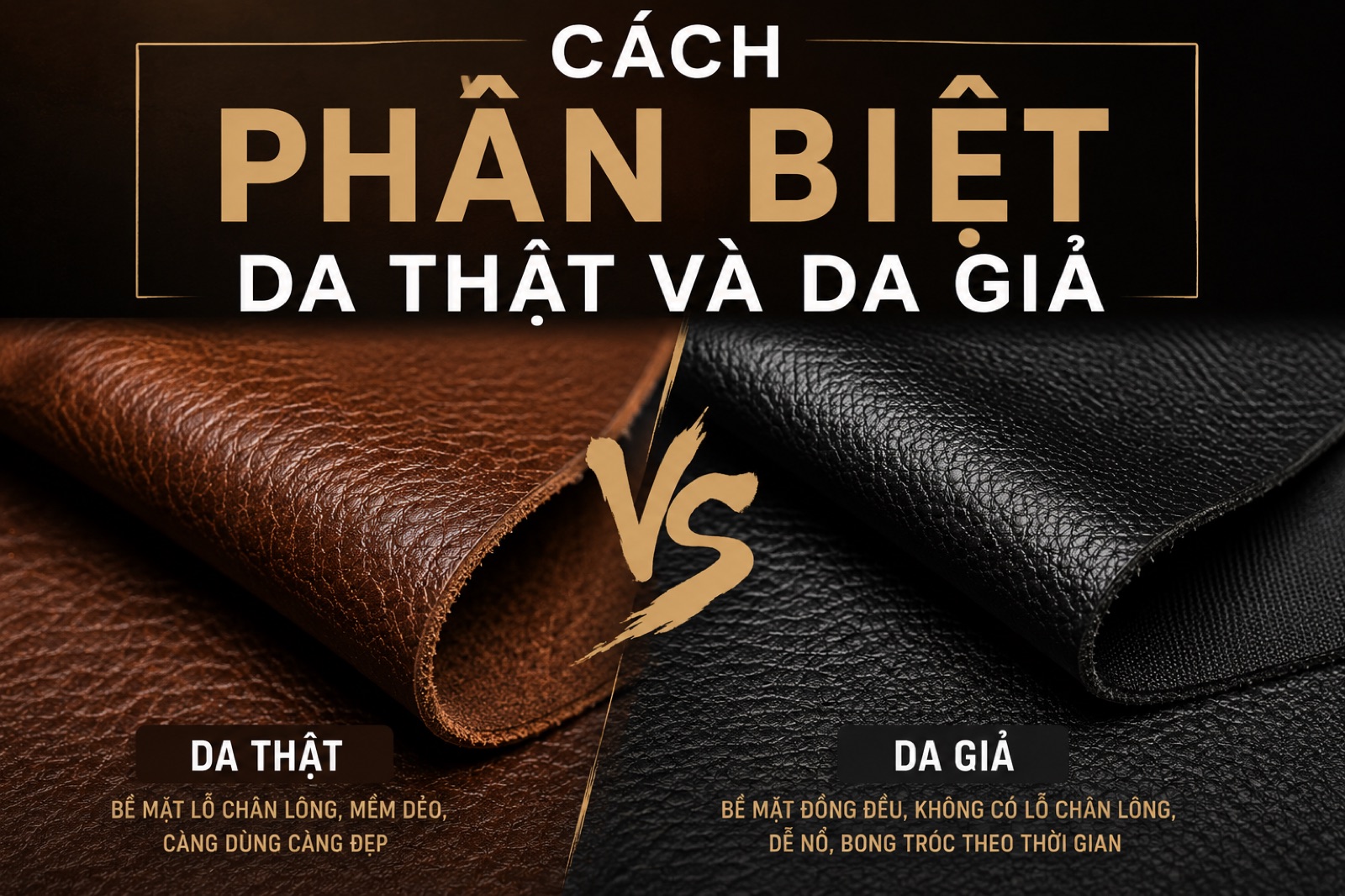
6 quick tests: ① Grain real is irregular — fake repeats a pattern; ② Pores visible on real leather — fake is flat and featureless; ③ Finger press real leather forms natural radiating wrinkles — fake just dents and springs back; ④ Water drop real leather absorbs slowly and darkens — fake beads up; ⑤ Smell real has a distinctive earthy scent — fake smells sharply of plastic/chemicals; ⑥ Cross-section real shows fiber strands — fake shows a fabric backing. For certainty, combine at least 3 tests.

Top 3 brands customers bring to Gazano: Louis Vuitton · Hermès · Gucci — and plenty of items labeled "genuine leather" turn out to be PU-coated once you inspect the cross-section.
Vietnam's market is flooded with products labeled "100% genuine leather" that are actually simili, PU, or low-grade "genuine leather" coated in plastic. Handling thousands of leather items every year, Gazano meets plenty of customers surprised to learn their "genuine leather" bag can't be conditioned — because it's synthetic. This article compiles the tests our experts use every day, so you can apply them right in the store before spending your money.
6 on-the-spot tests — no tools required
| Test | Genuine leather | Fake leather (simili/PU) |
|---|---|---|
| 1. Look at the grain | Irregular grain that varies from area to area, sometimes with tiny natural scars | Perfectly uniform grain, repeating like a printed pattern |
| 2. Inspect the pores | Tiny pores are visible (clearest under angled light) | Surface is completely flat, or has identical fake printed pores |
| 3. Press with a finger | Small wrinkles radiate around the pressure point and recover slowly | Just dents and springs back, with no radiating wrinkles |
| 4. Water drop | Absorbs slowly after a few seconds; the spot darkens, then evaporates | Water beads up and wipes away cleanly |
| 5. Smell it | The distinctive earthy scent of tanned leather | Smells of plastic, chemicals, or glue |
| 6. Cross-section / edge | Densely interwoven leather fibers are visible | A woven fabric or foam backing shows beneath the plastic film |
Applying heat gives accurate results but destroys the product and is dangerous — no store will allow it, and Gazano doesn't recommend trying it at home.
Beware the "genuine leather" trap and PU-coated split leather
Not all "real leather" is good. Cowhide quality ranks from highest to lowest: full-grain → top-grain → genuine/split leather → bonded leather (compressed leather scraps).
- Genuine leather sounds premium but is actually split leather — the lowest-grade layer of the hide, usually coated with a PU film embossed with fake grain. In feel and durability, it's closer to fake leather than the real thing.
- Bonded leather is ground leather scraps mixed with glue and rolled thin — it peels after 1–2 years, and no conditioner can save it.
- "Genuine leather" goods priced far below market rate almost certainly fall into these 2 categories.
To dig deeper into leather grades, read our article What Is Full-Grain Leather and Why Does It Cost More? (coming soon in this knowledge series).
Knowing your leather type — the prerequisite for proper care
This is why Gazano always identifies the leather type before taking on any item:
- Genuine leather needs regular conditioning (Renovateur, conditioning creams) — the more you care for it, the more beautiful it becomes over time (patina).
- Da PU/simili CANNOT absorb conditioners — applying cream only leaves a dust-trapping film. Proper care for synthetic leather is wiping clean + air-drying, and accepting a 2–5 year lifespan.
- Peeling on PU leather is irreversible (the plastic film has broken down); color peeling on real leather, however, can be re-dyed.
Not sure what leather your item is? Send close-up photos (grain + cross-section) via Zalo Gazano — our experts reply the same day.
Does real leather peel?
Full-hide leather (full-grain, top-grain) doesn't peel — it only dries out, scratches, or fades, and all of that can be restored. Peeling in patches is a sign of PU-coated or bonded leather.
Are designer bags always real leather?
Most authentic lines use premium real leather, but many houses also make coated-canvas lines (like LV Damier/Monogram) — these need dedicated care products (Saphir MDO Coated Fabric), not regular leather conditioners.
Does real leather deteriorate on its own over time?
Yes — if it isn't conditioned. Tanned leather gradually loses its oils, leading to dryness, brittleness, and cracking. Leather goods kept in storage need regular conditioning and proper mold protection all the more.
Which test is the most accurate?
Checking the cross-section/edge (for fiber strands) and inspecting the pores are the 2 most accurate non-destructive tests. Add the press-and-rebound test and you can be nearly certain.