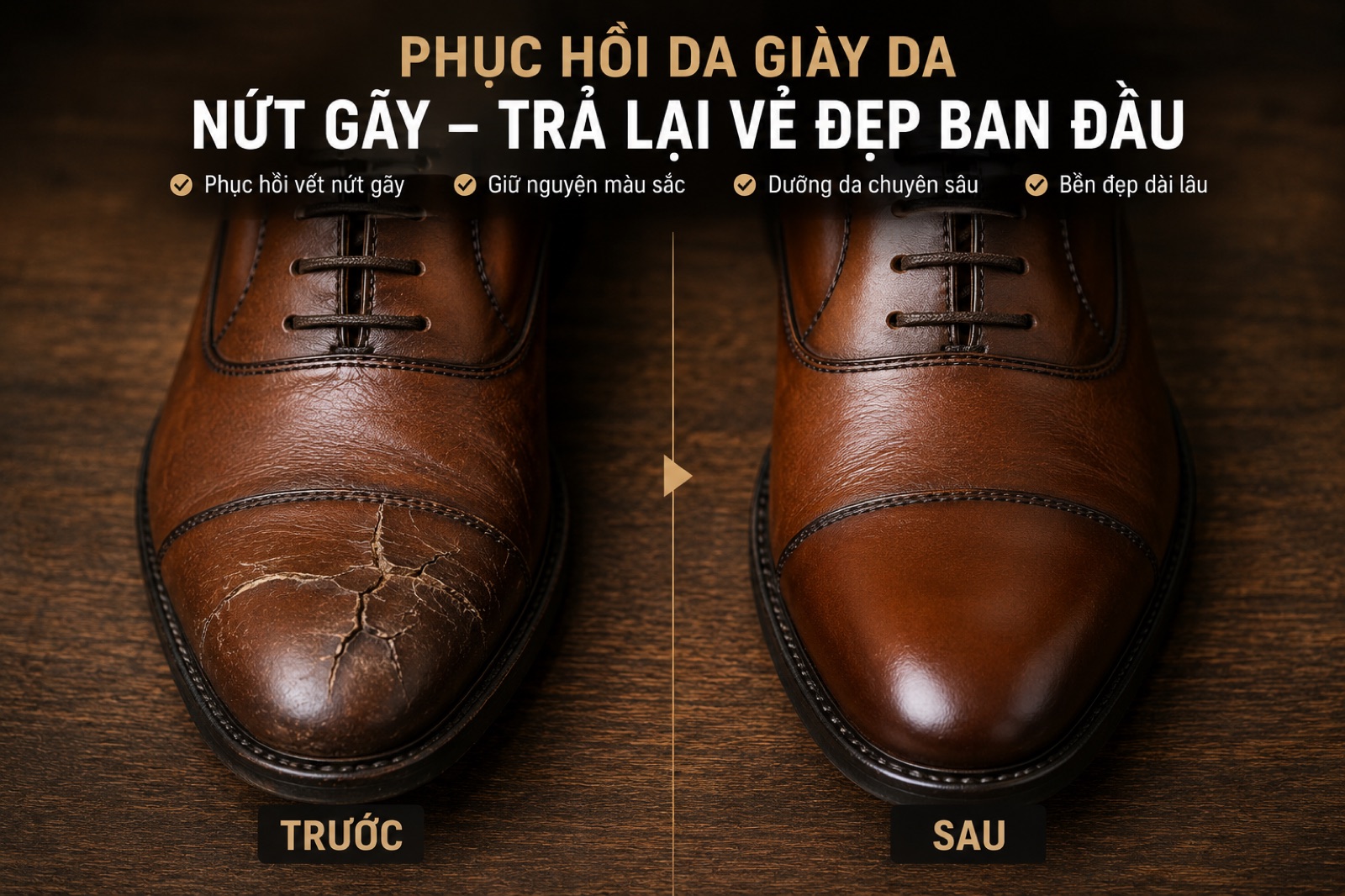
Light surface cracking (spider-web cracks) can be restored almost completely with deep conditioning + color-matched cream polish. Moderate cracks that have eaten into the leather need a professional to apply filler + redyeing (from 1,000,000₫ at Gazano). Leather that has torn clean through the grain can never look new again — it can only be blended and reinforced for continued wear. The rule: the sooner you act, the better the result.

Toe cracking is among the most common problems during northern Vietnam's dry season. Most grade 1–2 cracks brought in early show clear improvement after restoration.
Cracked shoe leather is the result of leather staying dry for too long: it loses its natural oils, the fibers turn brittle, and they break at the most-flexed point — usually the toe. Across the more than 6,000 pairs Gazano has treated, toe cracking ranks among the most common problems in northern Vietnam's dry season. The good news: the vast majority of cases improve significantly — if you identify the crack grade correctly and treat it the right way.
Identifying the crack grade correctly — it determines 90% of the outcome
| Grade | How to tell | Restorability | How to treat it |
|---|---|---|---|
| 1. Spider-web cracks | Fine surface crazing; a fingernail glides over without catching | ✅ 90–100% | DIY at home: deep conditioning + cream polish |
| 2. Cracks into the leather | Clearly visible crack grooves; a fingernail catches; the base color shows through | ⚠️ 60–80% (blended + evened-out color) | Professional: filler + redyeing |
| 3. Torn through the grain | The leather splits into an open gap that can spread apart when flexed | ❌ Won't return to original — reinforce for continued wear | Professional: patching, reinforced bonding, concealing dye |
Run a fingernail lightly across the crack: glides smoothly → grade 1 · catches slightly → grade 2 · the nail "drops" into a gap → grade 3.
Light cracks: at-home restoration routine (grade 1)
Clean thoroughly
Use a dedicated leather soap and let the shoes air-dry — never in harsh sunlight or with a hair dryer.
Deep conditioning, 2–3 layers
Apply Saphir Renovateur in thin layers, allowing 30 minutes between coats. Once the leather has "drunk" enough conditioner, it softens and the cracks gradually close.
Restore color with cream polish
After 24 hours, apply cream polish in the matching shade to evenly cover the cracked area.
Insert shoe trees to keep it taut
Keep the cracked area flat throughout the process — if the crease keeps flexing, the crack keeps opening.
Repeat the conditioning cycle weekly for 2–3 weeks. No improvement → the crack is deeper than you think; switch to professional repair.
Moderate to severe cracks: the professional restoration process
At Gazano, level 2–3 cracked shoes go through this process: deep cleaning → stripping the old finish → filling the cracks → smooth sanding → alcohol-based Saphir dyeing → color sealing + conditioning. Alcohol-based dye penetrates the leather instead of coating it, preserving its softness and grain.
- Costs color restoration & repair: from 1,000,000₫ depending on the damage level and leather type.
- Turnaround: usually 5–7 days (pickup & delivery available in Hanoi).
- Free assessment: send photos of the cracks via Zalo 0936.297.486 — Gazano will confirm the severity level + price the same day.
If restoration costs exceed 50–60% of the shoes' remaining value and the leather has widespread level 3 cracking — instead of repairing, invest in a new pair and care for it properly from day one.
Preventing cracks from returning — 10 times cheaper than fixing them
- Condition regularly every 4–6 weeks — leather is like human skin: without moisture, it cracks. See the recommended polishing schedule.
- Always use shoe trees after each wear — reduces toe creasing by 80%.
- Rotate 2–3 pairs, and don't wear the same pair for days in a row — leather needs 24 hours of "rest" to release moisture.
- Avoid heat sources: don't dry shoes next to a heater or in harsh sunlight — heat is the number one culprit that strips oils from leather.
Should I apply coconut oil or Vaseline to cracked shoes?
No. Coconut oil and Vaseline soften leather temporarily but clog its pores, attract dust, and cause staining that's hard to fix later. Use a conditioner made for leather (Saphir Renovateur, Gazano leather conditioner).
How long does cracked-shoe restoration take?
Home conditioning: visible improvement after 2–3 weeks. Professional restoration at Gazano: usually 5–7 days, with home pickup available in Hanoi.
Can cracks come back after restoration?
Yes, if the leather is allowed to dry out again. After restoration, keep conditioning every 4–6 weeks and use shoe trees — filled areas need even more consistent moisture than the original leather.
What causes leather shoes to crack most often?
The top three causes: going too long without conditioning, drying with heat (hair dryers, direct sun), and wearing one pair continuously so the creases are overworked.