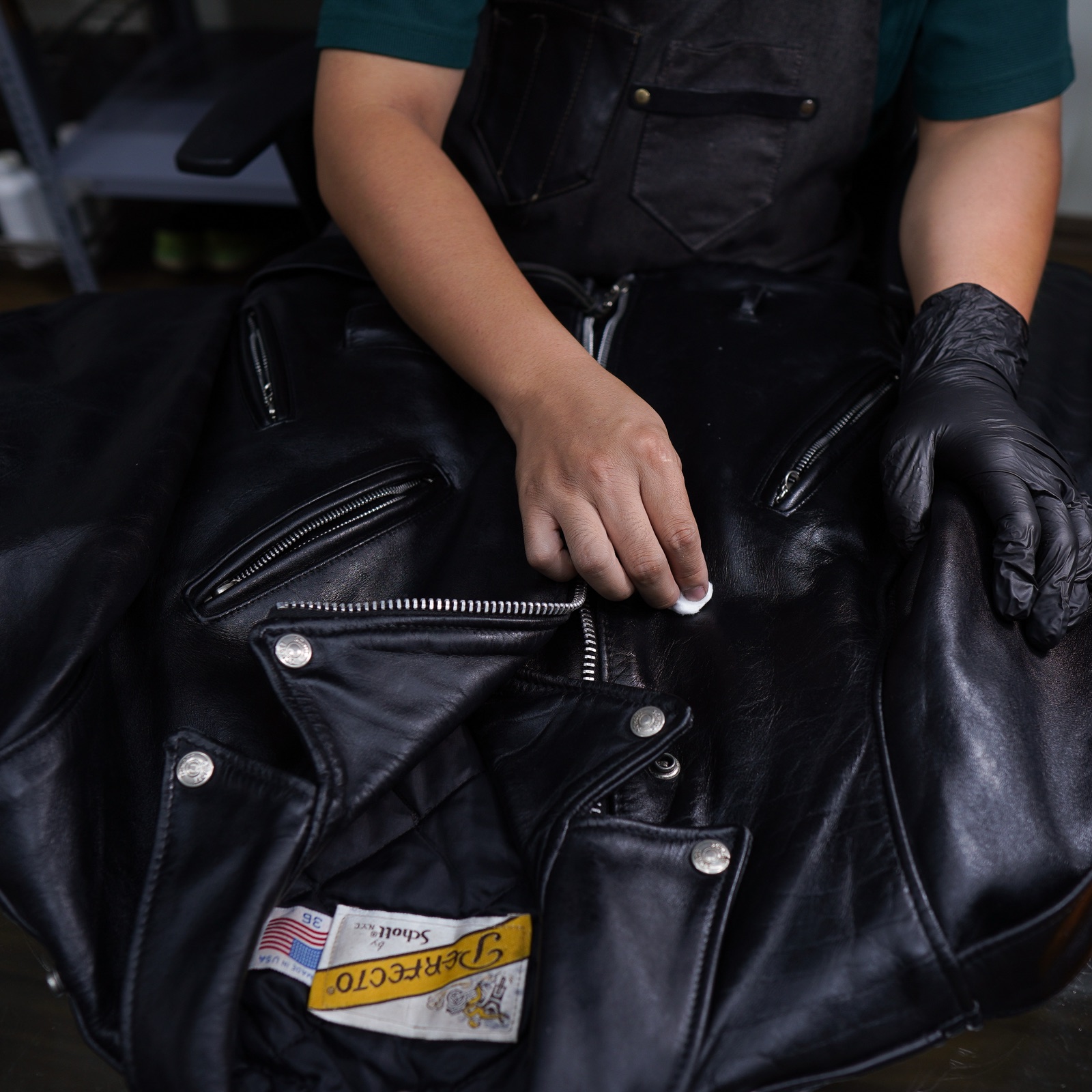
A jacket that has only just gone dry and stiff, with no fiber breakage, can be softened back almost completely — through multiple layers of deep conditioning so the leather "drinks" the oils back in and regains its suppleness. If the leather has already suffered fiber breakage (cracks that split open when folded) it can only be softened + reinforced for continued wear — it won't return to its original state. Absolutely avoid coconut oil and Vaseline — use only conditioners made for garment leather. Pigmented or designer jackets should be conditioned by a professional to avoid lifting the finish.

A leather jacket stored away for months without conditioning will, once the dry season hits, turn dry and stiff at the elbows, shoulders, and collar first — the areas that flex the most.
A dry, stiff jacket is the result of leather losing its natural oils: long storage without conditioning, sun exposure, or heat drying makes the fibers contract and lose their flexibility. Just like dehydrated human skin, garment leather can "drink" the oils back in and soften again — as long as you act before the fibers crack and break.
Dry and stiff, or already cracked? — this determines how much can be saved
| Condition | How to tell | Restorability |
|---|---|---|
| Dry and stiff, not yet cracked | Leather is stiff and less supple, possibly with fine surface crazing | ✅ 90–100% — deep conditioning restores softness |
| Surface cracking | Visible cracks that don't split open when folded | ⚠️ 70–85% — conditioning + color touch-up on cracked areas |
| Broken leather fibers | Cracks split open when folded, exposing the inner layer | ❌ Won't return to original condition — reinforce for continued wear |
Gently fold the suspect area: leather is merely stiff, no new cracks → dry and stiff (very saveable) · cracks appear → surface cracking · cracks split open, exposing the inner layer → broken fibers, needs a professional.
Softening a dry, stiff leather jacket at home
Clean gently
Wipe off dust and dirt with a damp cloth or a leather cleaning solution, then air-dry in a ventilated spot — no sun, no blow-drying.
Deep conditioning, 2–3 layers
Apply a thin layer of conditioning cream/wax made for garment leather (Saphir Renovateur, nappa conditioner), letting each layer absorb for 20–30 minutes. Prioritize the elbows, shoulders, and collar.
Work the leather supple
Once the conditioner has absorbed, gently flex the leather and try the jacket on so it settles back "into shape" — movement distributes the oils evenly.
Hang on a wide hanger
Hang the jacket on a wide wooden hanger in a ventilated spot and avoid folding — keep the leather flat while it recovers.
Repeat 2–3 times, a few days apart. The leather usually softens noticeably within 1–2 weeks. No improvement → the leather is deeply dried out or already cracked; switch to a professional.
Cracked or designer jackets: professional restoration
Cracked, pigmented, or designer leather jackets (Schott, Belstaff, Vanson…) should go to a professional. At Gazano, the process includes: deep cleaning → moisture-restoring conditioning → filler & reinforcement of cracked areas → color touch-up/re-dyeing (for pigmented jackets) → color sealing + finishing conditioner, restoring softness and even color without lifting the finish.
- Services leather jacket & bag cleaning and restoration: quotes based on surface area, material, and extent of damage.
- Free assessment: send photos of your jacket (especially the elbows and shoulders) via Zalo 0936.297.486 — Gazano provides a plan + quote the same day.
Washing machines, hot steaming, and dry-cleaning solvents strip the leather's oils quickly and lift the pigment coating — one of the reasons dry, stiff jackets get even worse. Leather jackets need specialized cleaning and conditioning.
Preventing dryness and stiffness — many times cheaper than restoration
- Condition every 2–3 months, more often in the dry season — well-moisturized leather never goes dry and stiff.
- Hang on a wide hanger in a ventilated spot, and avoid keeping it folded for long periods, which creates crease breaks. See leather goods storage principles.
- Avoid sun & heat sources — no sun exposure, no drying next to a heater.
- Not wearing it over summer: store it in a ventilated spot with a desiccant, and take it out occasionally to "breathe" and get conditioned.
Can a dry, stiff leather jacket be softened again?
If the leather has only just gone dry and stiff, with no fiber breakage, it can be softened back almost completely with multiple layers of deep conditioning — once it "drinks" enough oil, it becomes soft and supple again. If the fibers have already broken (cracks split open when folded), it can only be softened and reinforced for continued wear.
Should I use coconut oil or Vaseline to soften a leather jacket?
No. Coconut oil and Vaseline soften leather temporarily but clog its pores, causing stickiness, staining, and rancid oil over time. Use conditioning creams/waxes made for garment leather that absorb deeply without sealing the leather.
How does softening a pigmented leather jacket differ from uncoated leather?
Pigmented leather needs the right type of conditioner so the finish doesn't lift; apply thinly and test on a hidden spot first. Aniline/nappa jackets absorb conditioner faster. Given the higher risk, pigmented or designer jackets are best conditioned by a professional.
How long does softening a leather jacket take?
Home conditioning shows improvement after 1–2 weeks with 2–3 spaced-out applications. Professional restoration at Gazano typically takes 5–7 days, with pickup and delivery available in Hanoi.