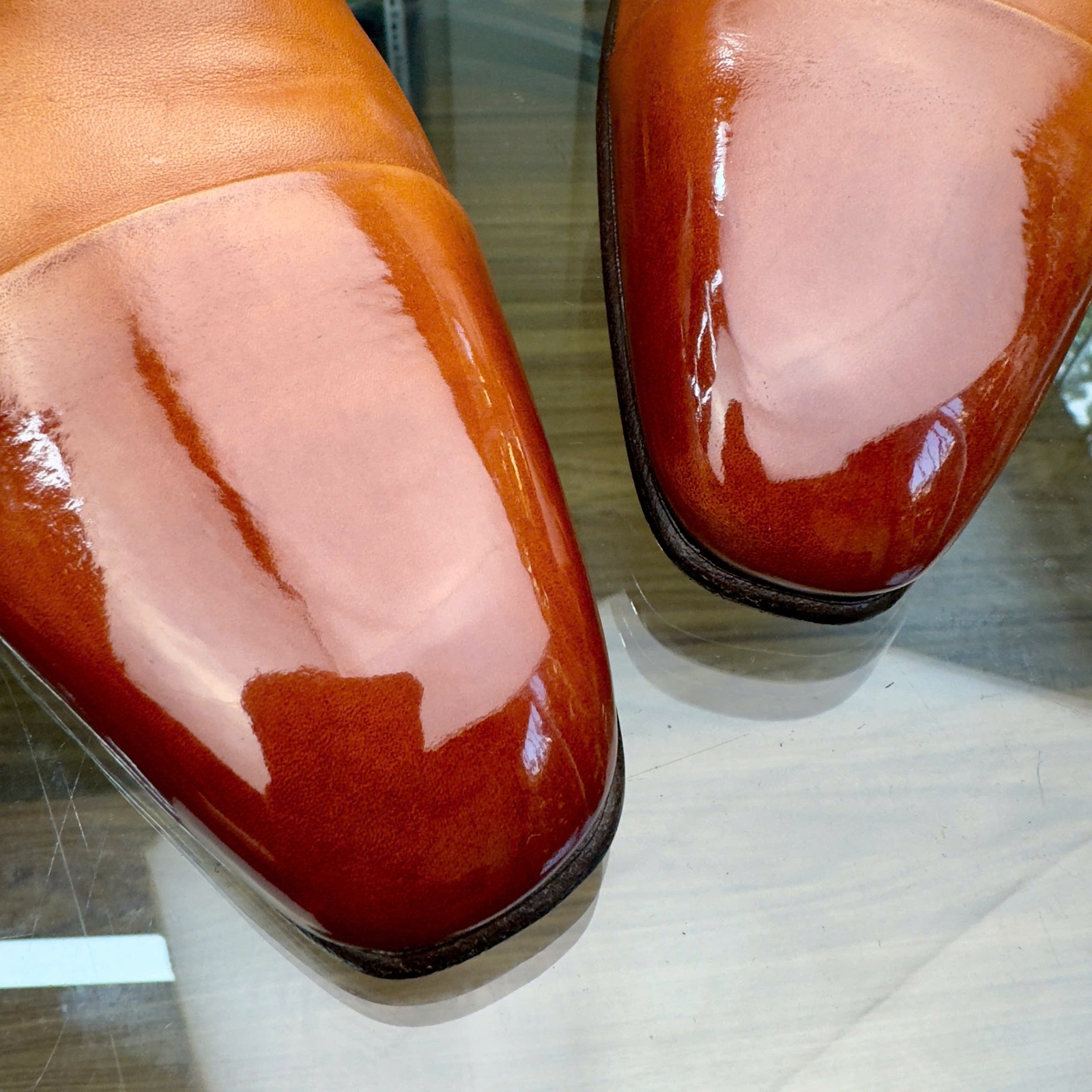
A mirror shine is the technique of building glass-like wax layers on the toe and heel — the flat areas. The toe can gleam because many thin coats of wax, worked in with a little water, fill the pores and grain into a light-reflecting plane.

Official partner Saphir (France) & Santoni (Italy); featured by VTV, VnExpress and Dân Trí.
The full answer
The principle: natural leather has pores and grain that scatter light (matte). By working ultra-thin layers of hard wax polish (Saphir Pâte de Luxe) with a few drops of water, the wax gradually fills those gaps, creating a smooth, flat surface that reflects like a mirror. Technique: wrap a cotton cloth around your fingertip, pick up a touch of wax and a drop of water, and buff in light continuous circles for 15–20 minutes, building layer upon layer. Only do this on the toe and heel (flat, low-flex leather); NEVER on flex points or pebbled/nubuck leather. It takes patience and a steady hand.
Want mirror-shined toes without doing it yourself? Gazano offers Mirror Shine polishing (part of our leather shoe cleaning & care service from 300,000₫). — see service details or chat Zalo.
Why won't your shoes shine no matter how much you polish? 5 common mistakes
Shoes that won't shine usually come down to 5 mistakes: (1) old polish never stripped, so new polish won't grip; (2) applying it too thick; (3) no water when building the shine; (4) skipping the brush/cloth buffing step; (5) polishing leathers that don't shine (pebble grain, nubuck, dead finishes).
How many steps are in a proper shoeshine, and in what order?
A proper shoeshine has 5 steps, in order: (1) brush off dust with a horsehair brush; (2) clean and strip old polish; (3) moisturize with renovateur/conditioner; (4) polish (cream, then wax); (5) buff to finish. The right order gets the leather clean and hydrated before color and shine go on.
Shoe recoloring — which colors, how durable, how much?
Leather shoe recoloring can achieve a wide range of colors, including darkening or patina effects. Gazano uses premium Saphir alcohol-based dyes for superior adhesion and durability. Recoloring costs from 1,000,000₫, depending on the desired color, material, and area treated.