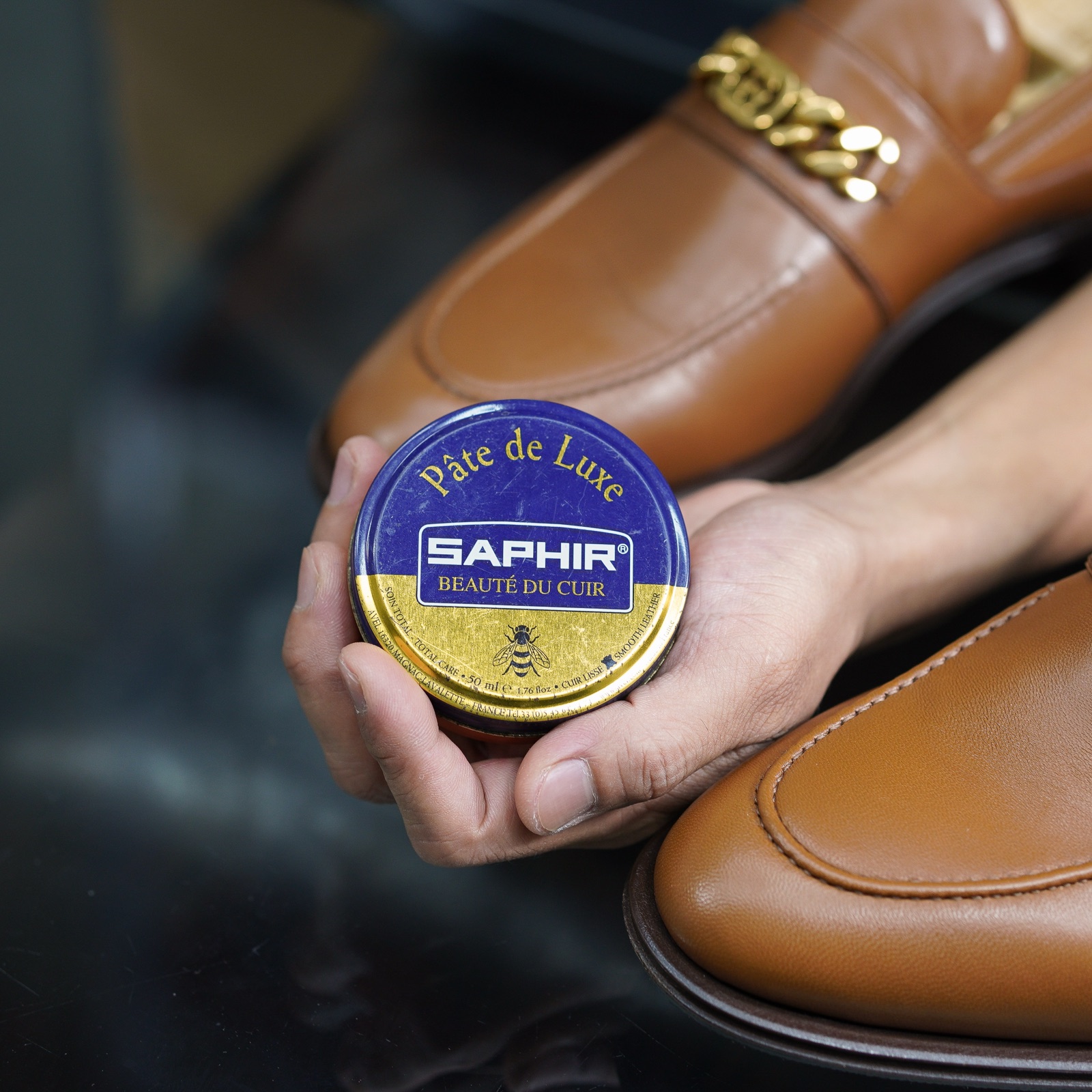
You shouldn't polish (deep-condition) every day. All your shoes need daily is a quick brush to remove dust and a wipe with a soft cloth. Heavy daily polishing doesn't make shoes look better — it builds up wax and clogs the leather's pores so the leather can't "breathe".

Official partner Saphir (France) & Santoni (Italy); featured by VTV, VnExpress and Dân Trí.
The full answer
Separate two things: a "quick shine" (brushing off dust + wiping with a soft cloth) can be done daily and won't harm the leather; "deep conditioning" (cleaning, moisturizing, and polishing to build a protective layer) should only be done every 4–6 weeks for daily-wear shoes. Too much built-up polish thickens and dulls the finish and blocks the leather from absorbing conditioner. After 8–10 consecutive polishes, strip the old wax with Saphir Renomat before conditioning again.
Not sure whether your shoes need conditioning or just a wipe-down? Send a photo via Zalo 0936.297.486 and Gazano will advise. — see service details or chat Zalo.
How often should you polish leather shoes?
Shoes in regular wear only need deep cleaning and conditioning every 1–2 months — never daily polish. Thick layers of polish don't improve the look; they just build up old wax. What matters is conditioning on rhythm so the leather never dries out.
How to keep shoes mould-free through Hanoi's damp season?
Hanoi's damp season (Feb–Apr), at 85–95% humidity, is when shoes mould most. The best defense is humidity control: silica packs in the cabinet, cedar shoetrees, and never storing shoes in sealed cardboard boxes.
How to properly treat leather shoes soaked by rain?
Rain-soaked shoes: blot dry with a soft cloth, insert shoetrees (or newspaper) to hold the shape and draw out moisture, then air-dry somewhere ventilated. Never dry with high heat.